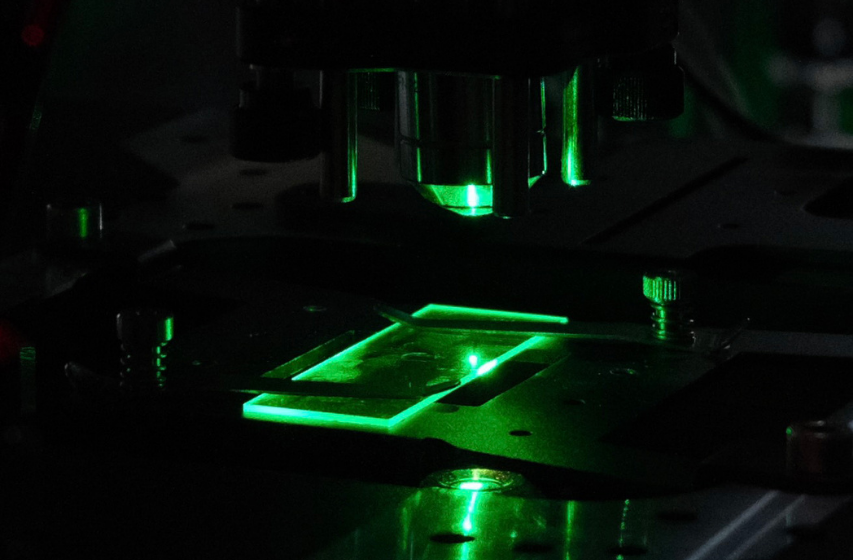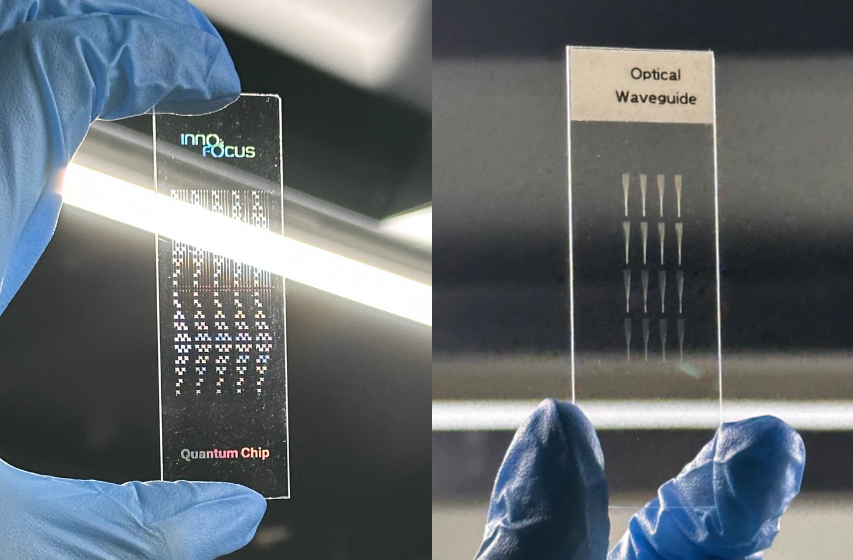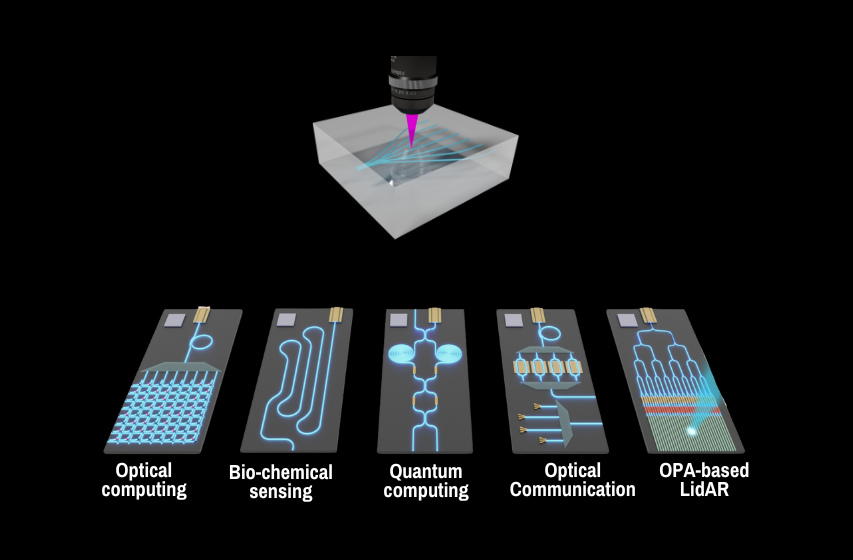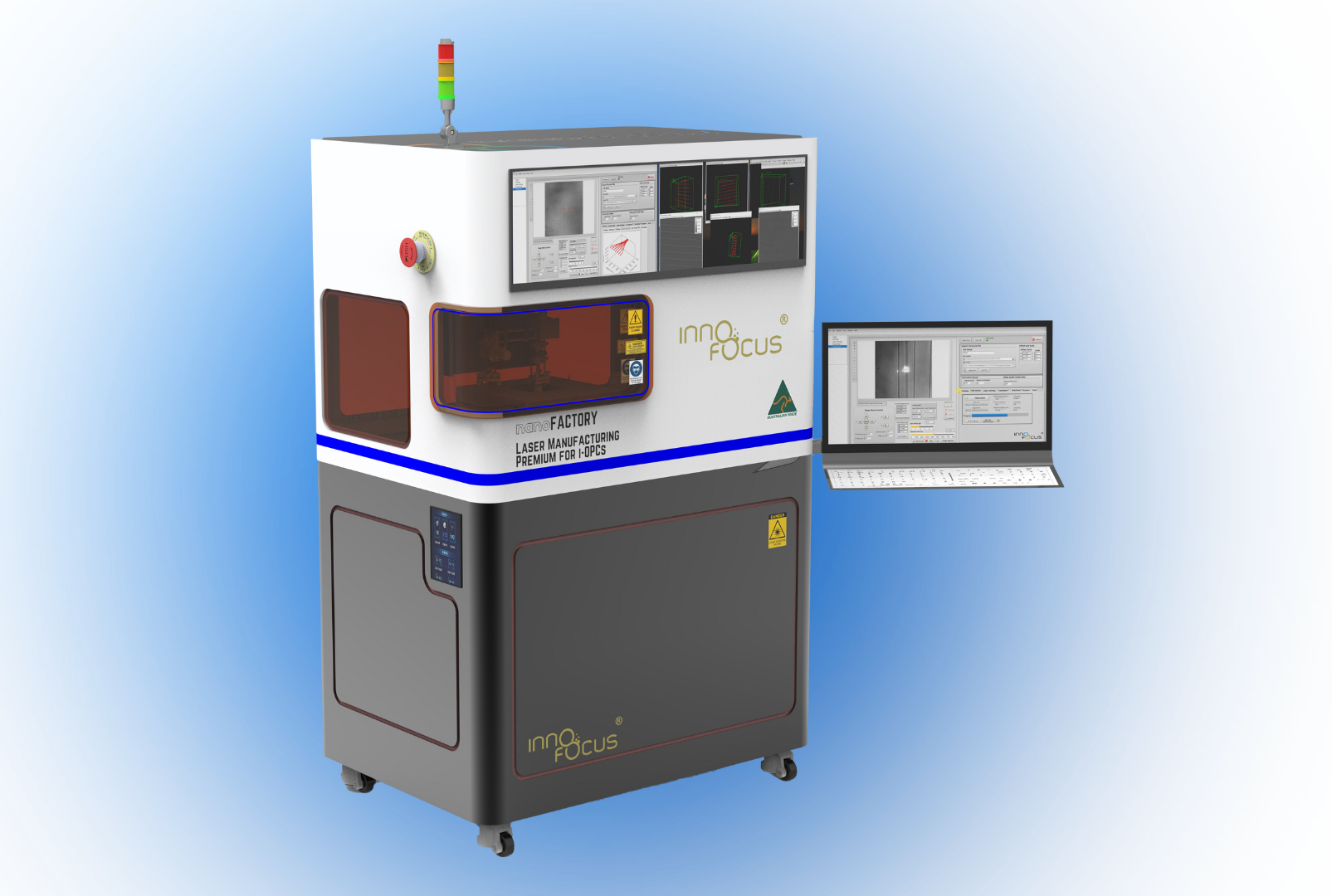
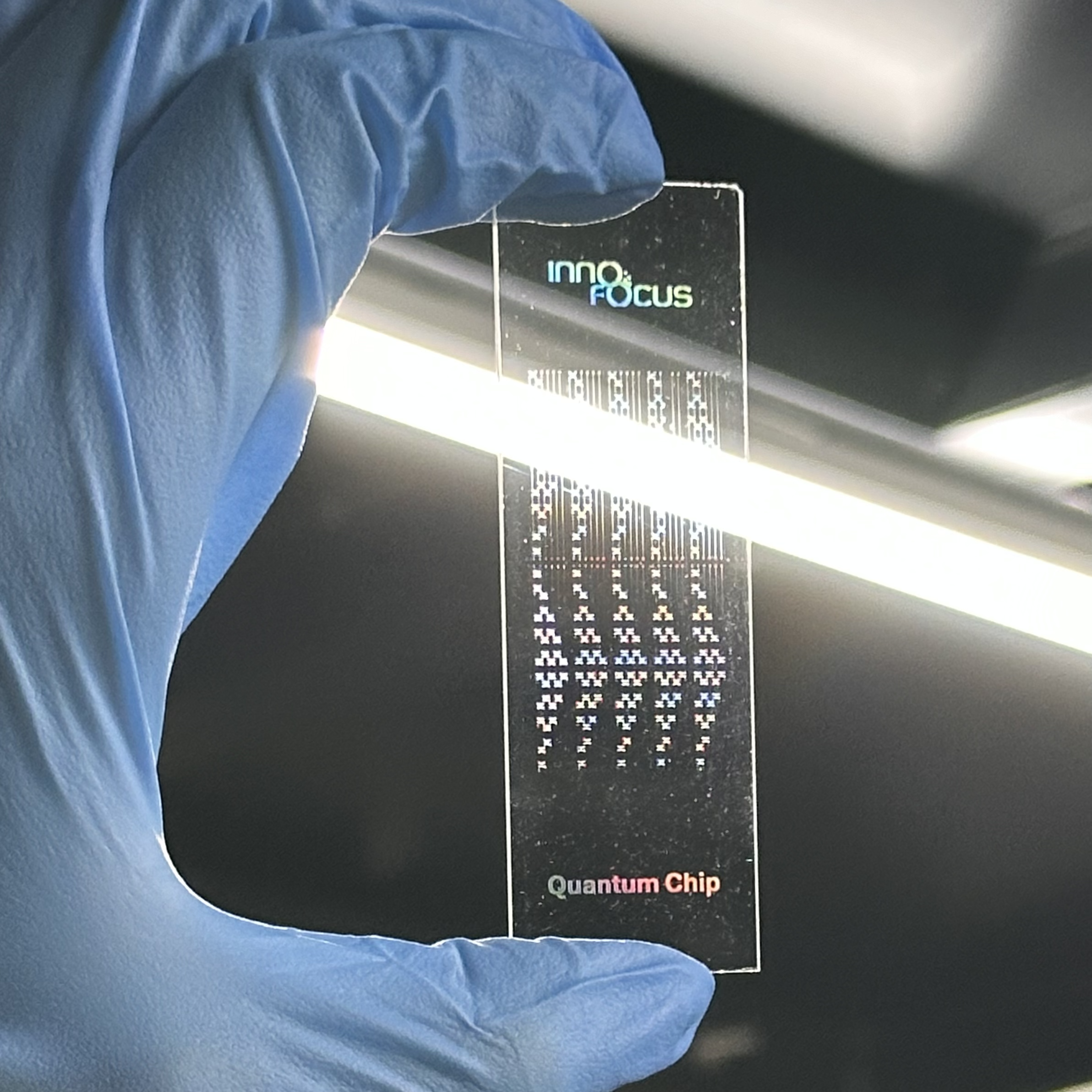
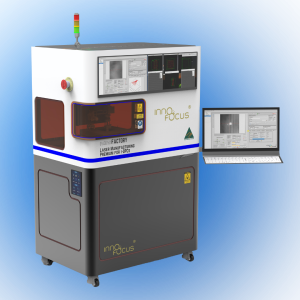
A one-stop manufacturing system that meets the needs of industrial-scale nanomanufacturing production lines to address the industry’s need for high efficiency and high yield, bringing a viable and reliable solution for minaturized photonic devices. The nanoFACTORY i-QPC equipment enables the industrial manufacturing capacity of highly complex nanostructures for applications such as quantum photonic chips, hyperspectral imaging, sensing devices, and optoelectronics.
New era with miniaturized photonic devices in optical communication, optical sensing and quantum techonology.
The rapid advancement of information technologies in the 21st century has indicated the approaching post-Moore’s law era. Moore’s law, which dictates the doubling of transistors on microchips every two years, has driven traditional computing technology for many years. The demand for higher speed, larger bandwidth, lower energy consumption, and improved security and stability in information technologies continues to grow. However, as we near the physical limits of miniaturisation, new approaches are needed to continue advancing computation.
Integrated Quantum Photonic Chips (i-QPC) have emerged as a promising successor to silicon chips. With the continuous development, i-QPCs which offer the desired features including high speed and low power consumption, has become the best solution for high-throughput communication technology. However, as i-QPCs move towards commercialisation and industrialisation, existing fabrication capabilities face significant challenges concerning precision, reproducibility, and scalability to fulfil the needs for R&D and manufacturing.
Conventional configuration of a laser nanofabrication system involves the segregation of distinct modules, with one dedicated to the fabrication process and another intended for characterisation purposes. Therefore, users have to remove the fabricated sample in order to characterise it and then optimise the outcome, leading to a multi-stage and time-consuming process. This hence presents a challenge to the quality control of photonic chips and i-QPC. Additionally, the multi-stage process can introduce error, which results in insufficient correlations between the characterisation results and the fabrication parameters.
To efficiently and accurately characterise nanostructure/nanopatterns of 3D photonic chips has been long sought. However we are yet to find a method that can accurately characterise the refractive index distribution as well as the surface morphology of the optical materials. To fabricate 3D optical structures in optical crystals, the difference in refractive index introduced by laser processing is particularly important, which determines the design of the optical component and its loss.
Bottleneck of sub 100 nm resolution
Innofocus developed the world-leading intelligent laser nanoprinting system, capable of fabricating arbitrarily designed 3D nano-structures with ultra-high precision (1000 times higher than commercial 3D-print), high yield and stability. It solves the low productivity bottleneck and simultaneously improves the quality, energy-efficiency of the fabrication process, promoting cost-effectiveness and competitiveness of Australian advanced manufacturing industry.
This fully Australian-developed technology with complete IP ownership addresses critical gaps in the international market through three revolutionary advances:
Surpassing Germany’s market-leading systems, deliver <10 nm accuracy at 400x the speed of conventional methods – a feat previously unattainable outside elite facilities. Unlike competitors requiring million-dollar cleanrooms, our AI-driven automation enables atomic-scale fabrication in standard-lab conditions, democratising access to quantum-grade manufacturing.
As the only commercially available system capable of mass-producing quantum photonic chips, our technology solves the critical bottleneck in photonic quantum computing:
With export to overseas, we’ve proven our capacity to outperform international competitors. It represents Australia’s best opportunity to lead $280 Bn quantum photonics market (McKinsey):
Innofocus Photonics Technology Pty Ltd
Unit 10/17 Helen Street, Heidelberg West 3081, Victoria, Australia
Fill out the form below and we'll get back to you as soon as possible.
"*" indicates required fields